Written by:
Steven Sim, Lead Educational Therapist, Gan Ru Jia, Educational Therapist, Janitha Panicker, Senior Educational Therapist, Azlina Ismail, Senior Educational Therapist, Mariel Tan, Senior Educational Therapist, Bella Kho, Senior Educational Therapist, Zakiyyah Binte Masri, Senior Educational Therapist, Julie Ting, Senior Educational Therapist, Tina Wong, Senior Educational Therapist, Azalea Birch, Senior Educational Therapist, Chye Khoon, Educational Therapist, Noorhidaya Abdul Majeed, Senior Educational Therapist
Part 1: Reflections from the ADHD/ASD Toolbox Creation at Tampines Learning Centre
A Shared Commitment to Intentional Practice
On 28 August 2025, Tampines Learning Centre gathered for an expert consultation session centred on our ADHD/ASD Toolbox initiative. In her opening address, Centre Manager Sofia reminded us that the purpose of the session was not merely to introduce tools, but to explore how they can meaningfully support students with ADHD and ASD in our classrooms. The toolbox, she emphasised, was created to provide practical, evidence-based strategies to address challenges, from cognitive inflexibility to emotional regulation and sustained attention.
With Ms Tina Tan guiding the discussion, the session became a collaborative space where Educational Therapists (EdTs) openly shared trials, observations and honest reflections from their classrooms. What emerged was not a catalogue of tools, but a deeper understanding of intentional implementation.
From Brainstorm to Classroom
The development of the ADHD/ASD Toolbox followed a thoughtful six-step process:
1. Brainstorm
With the needs of our students in mind, we brainstormed items that we could source and purchase to better support them. We discussed various sensory tools and regulation strategies that we believed would help with attention, emotional regulation and sensory processing. Careful consideration was given to practicality, inclusivity and suitability across different age groups to ensure that the selected items would be meaningful and effective in our classrooms.
2. Prioritise
After generating a list of possible tools, the team carefully evaluated each option based on impact, feasibility and cost-effectiveness. Consideration was given to which tools would benefit the greatest number of students while remaining sustainable within the $100 budget. With a $100 allocation, Bella, our Centre Representative, sourced selected sensory tools. At the same time, EdTs created several DIY resources, demonstrating that effective regulation tools do not always require expensive purchases. This balance between purchased materials and teacher-created tools reflects a key principle: innovation is not about cost, but intentionality. It is about understanding students’ needs, making purposeful decisions, and designing solutions that are practical, inclusive and sustainable. This step ensured that decisions were intentional rather than impulsive.
3. Trial
Selected tools were first trialled in classrooms on a small scale. Bella and Azalea piloted several of the tools with her students and later shared how they were used in practice. During this phase, attention was given to students’ engagement levels, behavioural changes and overall effectiveness of each tool. Her trial allowed other teachers to observe the impact firsthand, gather insights, and consider how the tools could be adapted for their own classrooms before wider implementation.
4. Feedback
Feedback was collected from both teachers and students. Teachers shared professional observations, while students provided insights into which tools they found calming, helpful or distracting. This collaborative approach ensured that the toolbox remained student-centred and responsive to actual needs.
5. Refine
Based on observations and feedback, adjustments were made. Some tools were repositioned, modified or rotated to maintain novelty and effectiveness. DIY resources were improved for durability and clarity. This reflective stage strengthened the overall quality and usability of the toolbox.
6. Share with a Larger Audience
Once refined, the ADHD/ASD Toolbox was introduced to a wider group of staff. The team shared the rationale, process and outcomes, encouraging others to adopt or adapt the approach in their own classrooms. By documenting the journey, the initiative became a scalable and sustainable model rather than a one-off project.
Introducing the Tools
| Tool | How these tools help |
|---|---|
| Wobble seat | Gentle motion of wobble seat supports focus and reduces restlessness. |
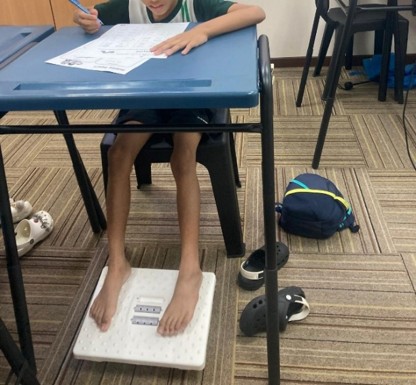
| Under desk rocking foot rest | It helps learners with ADHD stay focused by allowing quiet, calming movement. |
| Chairbands | It allows quiet leg movement, helping release energy and improve focus. |
| Sensory stones | To provide tactile input. |
| Sensory braided mesh hand fidget toys | To offer quiet hand movement, helping reduce stress and anxiety. |
| Emoji stress balls | Great for relieving stress and safely releasing anger. |
| Colourful hourglass | Schedule breaks, practise mindfulness and improve time management, while the colourful hourglass and flowing sand provide a calming focus. |
| Social inferencing flash cards (Pri) | Help learners understand others’ feelings, intentions and social cues to improve their social skills. |
| Coping skills card games (Sec) | These games help students aged 13–16 learn and practise healthy ways to manage stress and emotions. |
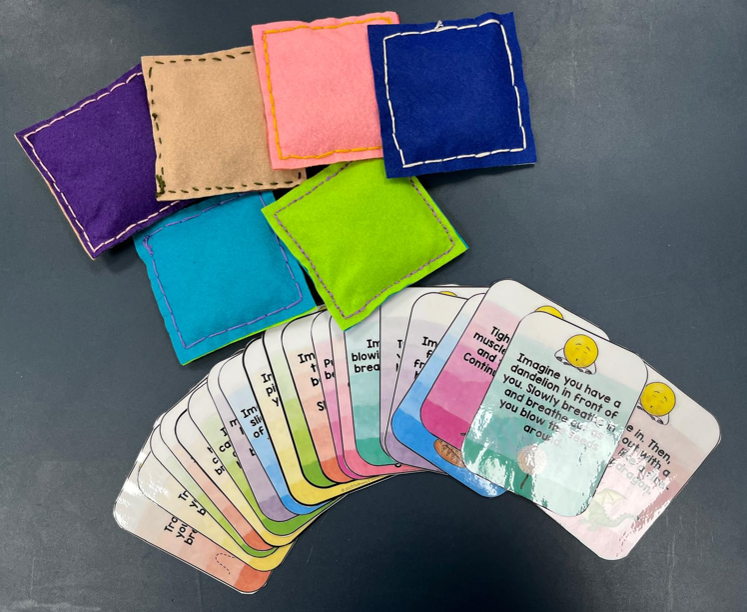
| DIY fidget beanbags | Fidget beanbags help improve focus and relieve stress through tactile sensory input and gentle movement. DIY beanbags crafted by EdTs make the experience more meaningful for students. |
| DIY mindfulness cards | Teach brief, easy mindfulness practices (breathing, grounding, body scans) to help students pause and refocus. |
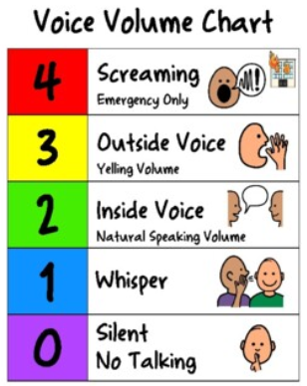
| DIY posters for calming and regulation strategies | Posters are proactive tools that help build a positive, self-regulating classroom culture. |
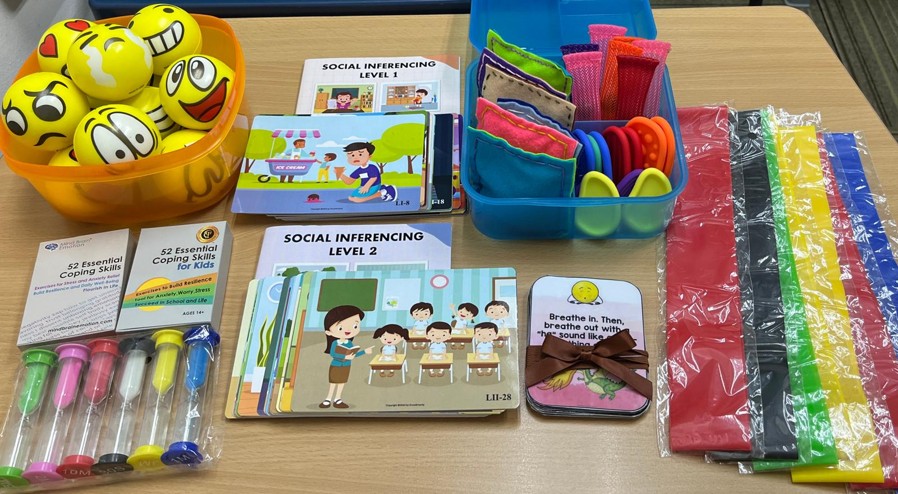
Tools in Action: What We Observed
As tools were trialled across levels, valuable insights surfaced.
Chair bands emerged as one of the most consistently effective tools. Zakiyyah observed that her Primary 6 student with ADHD was able to use the chair band purposefully and sustain focus during tasks when expectations were clearly explained. Similarly, CK noted that even upper primary and lower secondary students instinctively relied on chair bands when restless, almost as if the tool had become a natural extension of their workspace. Tina likewise observed increased engagement and on-task behaviour, while continuing to monitor its use to ensure it remained purposeful rather than a novelty.
However, modelling and boundaries proved critical. Ru Jia highlighted that chair bands and sensory fidget tools only supported regulation when their use was explicitly taught. Without guidance, students were prone to excessive fidgeting or distraction. Julie echoed this thoughtful caution, reflecting that tools can quickly become habits simply because they are present. She reminded us that tools work best when intentionally matched to both the student and the task, especially during short, focused activities such as independent writing.
Movement-based supports such as the under-desk rocking footrest yielded promising results. Janitha observed that although her student initially treated the footrest like a toy, the novelty gradually faded and movement became confined below the desk, significantly reducing impulsive behaviours such as flailing arms and muttering. Steven also noted that the under-desk rocking footrest worked well with his ADHD student, as it provided both movement and sensory input due to its design. Azalea similarly noticed a marked improvement in one student’s ability to focus and complete worksheets when using the rocking footrest. Interestingly, for the same student, the wobble seat became distracting as he constantly adjusted it for balance, reinforcing that one tool does not suit every learner.
Bella’s experiences further highlighted the importance of flexibility. Her student with ASD preferred placing the wobble seat on the floor to move his feet rather than sitting on it. Although seated duration improved from 15 to 30 minutes, hygiene and durability considerations emerged with shared equipment. Her trials with sensory stones, braided mesh fidget toys and DIY beanbags also revealed that tactile input can significantly support focus—though materials must be durable enough for repeated use.
Other tools demonstrated varying effectiveness depending on the student profile. Mariel reported that introducing a braided mesh fidget tool, with clear boundaries agreed upon, reduced her Primary 3 student’s tendency to touch classmates’ belongings, indicating improved self-regulation. Azlina found that a sensory fidget toy helped her Primary 4 student focus during writing tasks, though an emoji stress ball gradually lost its appeal. Meanwhile, Hidaya’s “Rip and Release Zone” provided students with a structured and constructive outlet for stress, showing that regulation strategies need not always be sensory objects — sometimes they are purposeful routines.
Across all trials, a consistent pattern emerged: tools are only as effective as the intentionality behind their use.
Key Takeaways
1. Some Tools Can Be Created, Not Bought
DIY mindfulness cards, fidget beanbags and structured regulation zones demonstrated that thoughtful design can be as impactful as purchased materials.
2. One Tool Does Not Fit All
What supported one student sometimes distracted another. Matching tools to learners and tasks is essential.
3. Short-Term Effectiveness Requires Monitoring
Initial success does not guarantee long-term impact. Tools may need adaptation as novelty fades.
4. “It Is a Tool, Not a Toy”
Tina’s reminder resonated deeply throughout the session. Without explicit modelling, boundaries and monitoring, tools risk becoming distractions. Their effectiveness lies not in the object itself, but in the intentional teaching that surrounds it.
Moving Forward
The ADHD/ASD Toolbox is not a fixed collection of items. It is a living framework shaped by observation, collaboration and refinement. This consultation reminded us that while tools can support regulation, it is our professional judgement, flexibility and reflective practice that ultimately drive meaningful change for our students.
At Tampines Learning Centre, we continue to refine not just the tools we use, but how we use them—ensuring they remain purposeful supports in our students’ learning journeys.