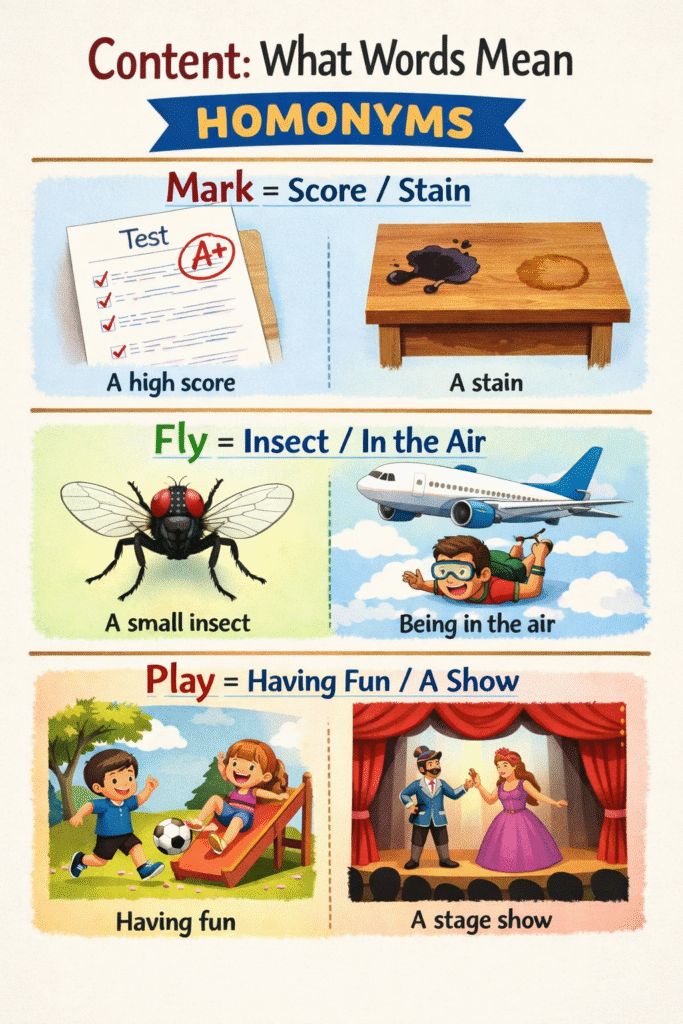
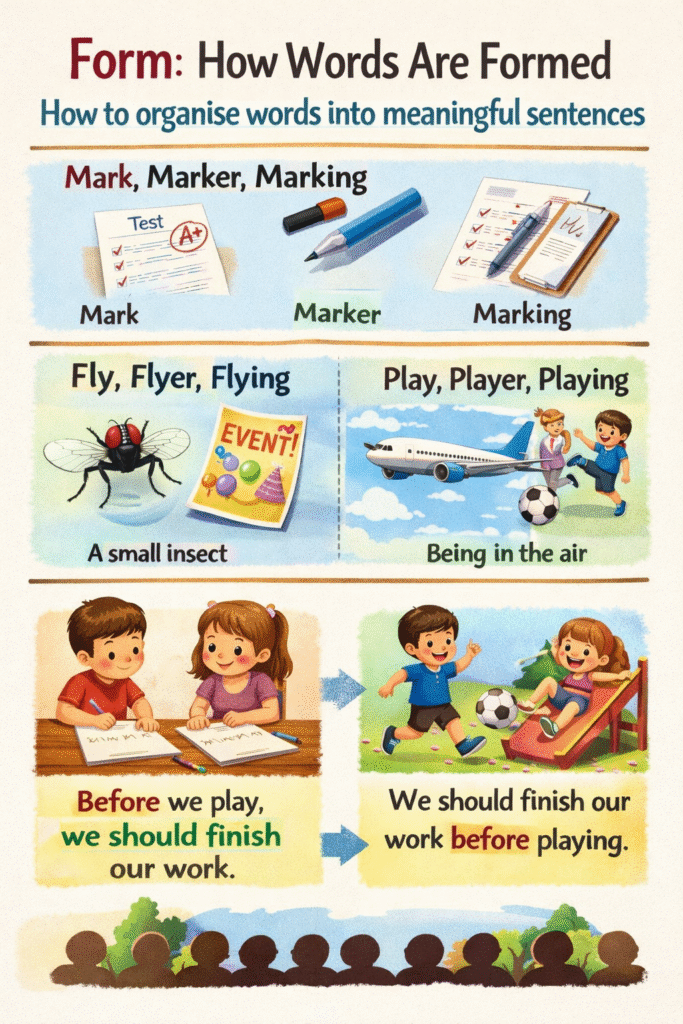
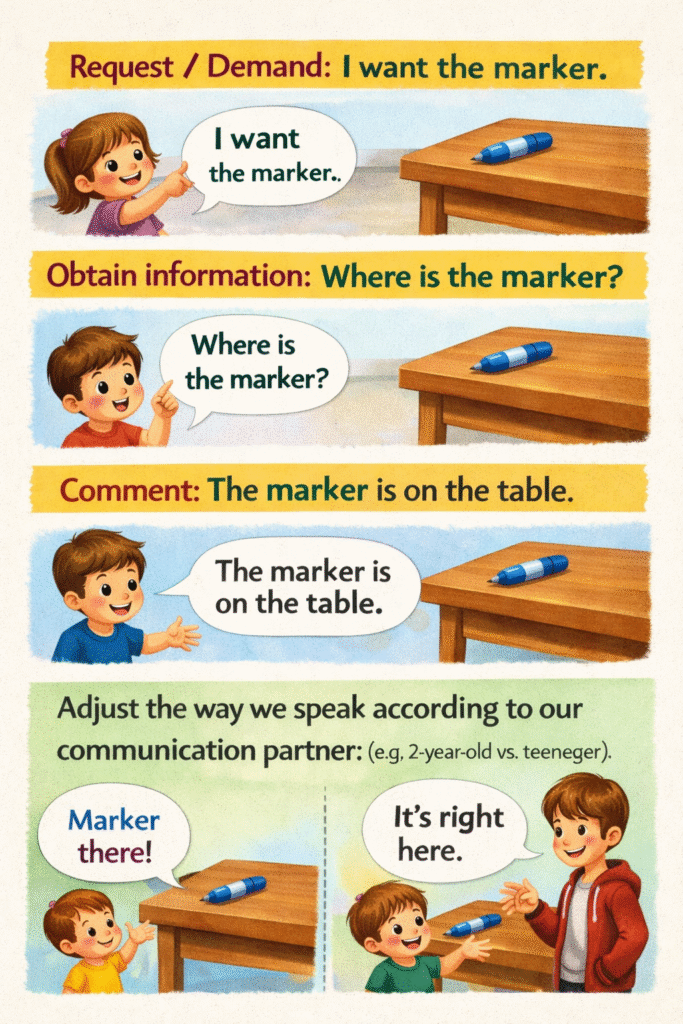
These different aspects of language come together in an integration for us to communicate effectively.
What are language difficulties?
There can be many breakdowns in a child’s language abilities that inhibit effective communication. These breakdowns can be in the child’s
(a) receptive language — how the child understands information given to him/her, and/or
(b) expressive language — how the child expresses his/her wants, needs, thoughts, and ideas.
How do we know what the child’s struggling with?
For example, you are reading a story to your child at bedtime. At the end of the story, you asked him, “Who was your favourite character?” and he answered, “The mother thing outside?”
While we are as confused as you, let’s take a look at what could have gone wrong in between!
| | Receptive Language | Expressive Language |
Content | – Does he understand that a “who” question requires him to answer with a person? – Does he understand what a “character” is? | – Does he have the vocabulary to refer to the “thing” in the story? |
Form | – Is he able to understand the question phrased in this manner? | – Is he able to use grammar rules to put the words into a proper sentence to express what he meant? |
Use | – Did he realize that the question was posed to him and he was expected to answer? | |
Some other characteristics of receptive and expressive language difficulties that you may observe include:
Receptive Language Difficulties | Observations in your child |
Difficulty remembering things that people say and/or following spoken instructions | Requires multiple repetitions or a slowed speech rate |
Shows poor understanding of the meaning of conversations/stories | Gives unrelated answers to questions asked |
Difficulty in understanding the meaning of words | Appears confused despite detailed explanations |
Shows confusion over words with similar sounds | Mishears ‘key’ for ‘tea’ / ‘cage’ for ‘cake’ / ‘cloud’ for ‘crowd’ |
Expressive Language Difficulties | Observations in your child |
Frequent use of words that lack specificity | “there/ that thing” |
Shows difficulty in finding the right words to express ideas | “uh..uh… that one” |
Narrates stories or events in a haphazard or incomplete manner | The burden is on the adult to ask questions to piece the story together. |
Uses poor grammar | “The boy third is drink water there.” |
Inappropriate substitution of a word with another word of similar meaning | “I cut the meat with a sword.” |
Speech is often filled with pauses, hesitations, repetitions, or vocalisations | “um… / you know” |
What is Language Therapy?
Now that we understand how your child may have language difficulties, what’s next? In language therapy, we typically assess the child to understand their needs and language profile. From there, we will provide intervention for identified areas of difficulty (i.e., form, content, use).
How do we target aspects of form, content, and use?
Based on the assessment, specific goals to support the child’s language are selected. During a session, the therapist will select fun and engaging activities such as games, storytelling, picture description, or role-play. Therapy sessions may include targets in these broad areas:
Listening:
- E.g., helping children understand what is being said by building background knowledge, vocabulary, and understanding different question types
Thinking:
- E.g., helping children build reasoning skills, understand cause and effect, and build inference skills
Speaking:
E.g., helping children learn to use accurate sentence structures, grammatical forms, and vocabulary to express their thoughts and ideas appropriately.
Through each activity, the therapist will support the child by breaking down the skills into smaller, manageable steps and providing support such as visual aids, modelling, and verbal prompts. As the child masters the skill, the therapist slowly fades the support to build mastery.
Parents are also updated about the goals in sessions and provided with strategies to support the child’s mastery of the skills at home.
As every child learns differently and at their own pace, therapy sessions are individualised and tailored to support each child’s needs. We aim to help your child build their confidence and support their communication needs in our sessions.
Click here to find out more about DAS Speech and Language Therapy.