“Thinking Differently, Feeling Deeply”: Killian’s Journey into Psychology and Purpose

Killian doesn’t speak loudly, but he listens deeply, learns intensely, and feels the world with a rare kind of insight. Currently completing his Honours degree in Psychology, Killian is researching emotional exhaustion in parents and the role of self-compassion. But his path here wasn’t straightforward.

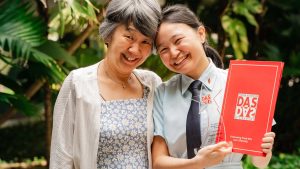
Diagnosed with dyslexia in primary school, Killian faced challenges that weren’t always immediately recognised. One educational psychologist thought there was nothing to worry about. But Tracy, his mum, knew something wasn’t quite right, and she trusted her instincts.

“The diagnosis doesn’t define you,” she told her sons. “But it gives us direction to work around what gets in your way.”

And direction made all the difference.

Killian responded well to DAS support and was one of the few students to graduate early from the Main Literacy Programme. He thrived on structure and visuals: linear notes, carefully organised, sometimes colour-coded with emojis or doodles. He hated mind maps; they were too chaotic. He needed logic and visual order to think clearly.

Behind that orderly mind, though, was a deeply emotional learner. In his younger years, Killian struggled with stress to the point of breaking pencils, rubbing his feet raw under the desk, and needing socks to soothe his sensory overload. These were not acts of defiance, they were quiet symptoms of overwhelm.

“I used to break pencils from stress,” he recalls. “I didn’t even realise how much I was carrying until someone showed me a better way to cope.

That someone was often his mum, and sometimes his younger brother, Keegan.

“I needed things broken down, simplified. Keegan helped me a lot with that. He has this ability to organise things when I couldn’t.”

While Killian helped Keegan with emotional regulation and social navigation, Keegan supported Killian in more academic ways, summarising notes, breaking concepts into manageable parts, and working through subjects together. They were a team.

In polytechnic, Killian nearly dropped out. The academic demands felt relentless. But instead of giving in, he doubled down on the strategies he knew worked. He learned when to push through and when to reset. He continued to build systems for managing time, stress, and content, and slowly, success returned.

Now, in university, he’s not just surviving, he’s contributing. His Honours research is focused, compassionate, and timely. He’s interested not only in children’s mental health, but in what it takes for parents to sustain themselves emotionally. That kind of insight doesn’t come from textbooks alone; it comes from lived experience.

“We can’t support kids if we ignore what their parents are going through,” he says simply.

Killian has become exactly the kind of psychologist the world needs: deeply observant, quietly empathetic, and fully aware that learning differently is not a deficit, but a different way of seeing the world.