

Identifying Mathematical Learning Difficulties
Mathematical learning difficulties can arise at nearly any stage of a child’s learning development. Dyscalculia is a condition that affects the ability to acquire mathematical skills.
Learners with dyscalculia face difficulty understanding simple number concepts, lack an intuitive grasp of numbers, and have problems recalling basic number facts and procedures. Even if they produce a correct answer or use a correct method, they may do so mechanically (without a deep understanding of the concept) or without confidence. Dyscalculia and dyslexia may occur both independently of each other and/or together. Here are some signs to look out for when identifying Mathematics difficulties:
1. Incomplete Mastery of Number Facts
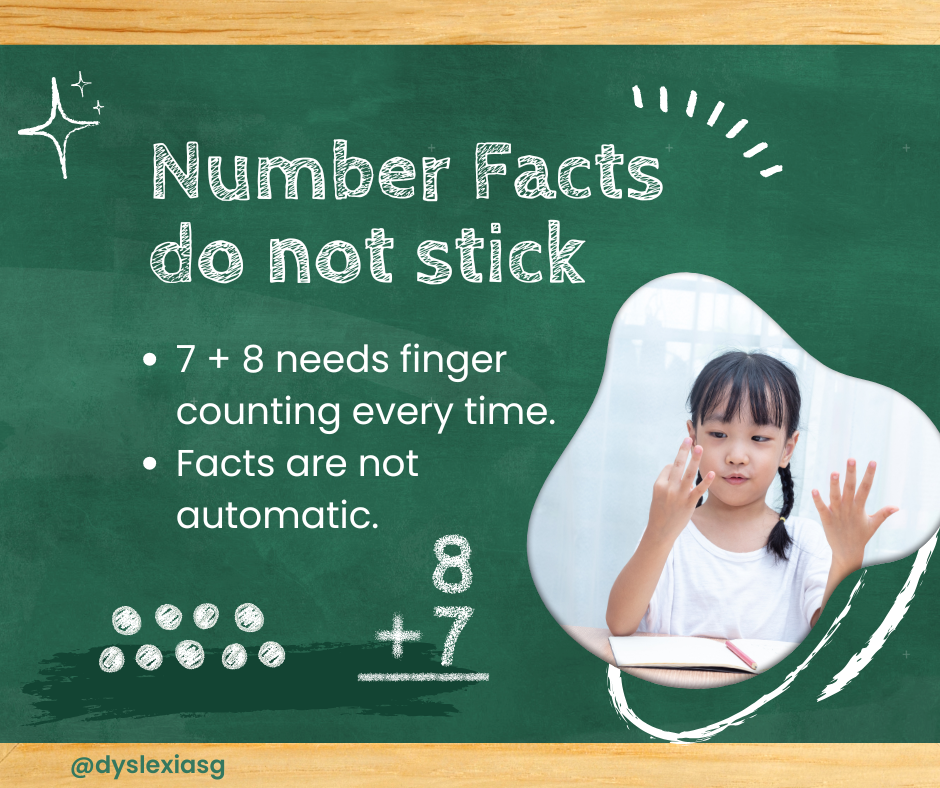
- Number facts are the basic computations that children are expected to pick up early on, such as knowing that 5 + 5 = 10 or that 2 Ă— 3 = 6. When a child cannot recall these facts efficiently, they may struggle to keep up with more advanced mathematical concepts.
- For example, during homework, a child might spend several minutes working out 7 + 8 by counting on their fingers each time instead of remembering it instantly. This can make problem-solving slow and frustrating, and may reflect underlying mathematical learning difficulties that warrant further investigation.
2. Computational Weaknesses
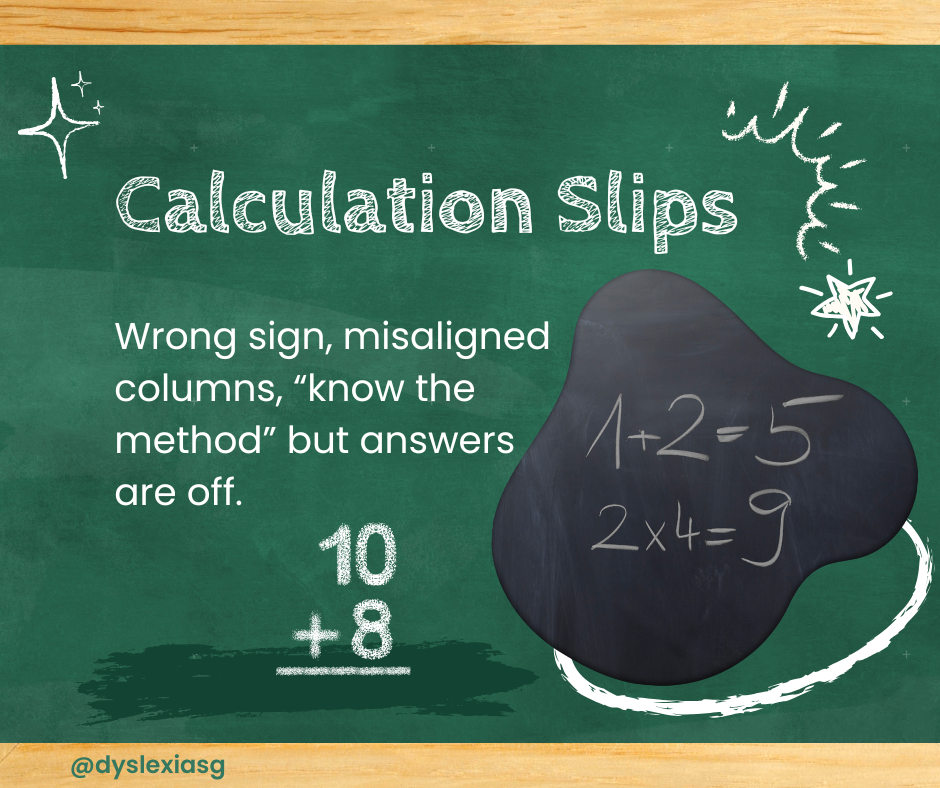
- Some children may understand mathematical concepts but still struggle when it comes to carrying out calculations. They might make frequent mistakes, such as adding instead of subtracting because they misread the sign, or writing the numbers in the wrong column during long multiplication.
- For example, a child who knows how subtraction works may solve 54 – 29 as 54 + 29, or when adding 236 and 47, they might accidentally place the “47” under the wrong digits, leading to an incorrect answer. At home, this may look like a child spending extra time redoing sums or feeling frustrated because their answers are not correct, even though they “know” the method.
3. Difficulties with Spatial and Directional Understanding
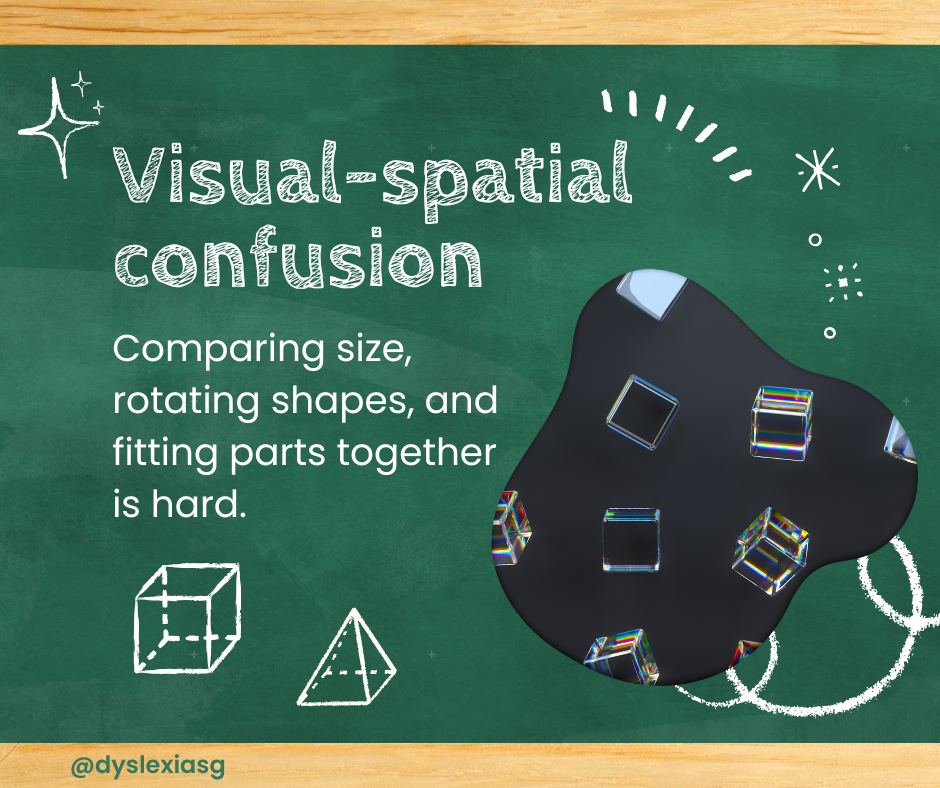
- Children who experience difficulties with spatial and directional understanding may find it hard to judge the relative size among objects.
- For example, when given three cups of different sizes, a child might struggle to tell which is the tallest or which holds the most water. Because of this, they often rely on rote memorisation of mathematical facts without truly understanding the concepts. These challenges can become more obvious in school when tasks require both higher-order thinking and visual-spatial skills, such as trying to imagine what a 3D block structure will look like if it is rotated, or figuring out how shapes fit together in a puzzle.
4. Difficulties with Making Meaningful Connections with Mathematics
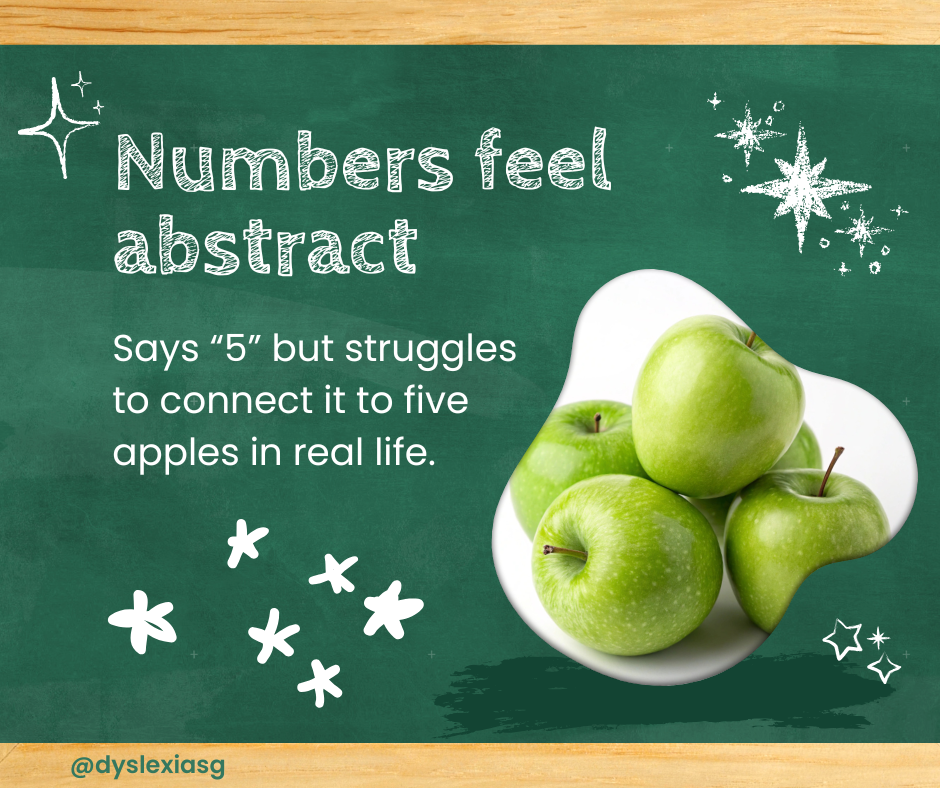
- Some children struggle to see how numbers relate to real-life quantities. For example, they may be able to say the number “5” but not immediately connect it to the idea of “five apples” on the table. Without this link, Mathematics can feel abstract, and skills that they have learned may not “stick” or carry over to new situations.
- A child might, for instance, know that 10 – 3 = 7 on a worksheet, but when asked, “If you had 10 sweets and ate 3, how many are left?” they may not realise that it is actually the same problem. This makes Mathematics hard to recall and apply beyond rote memorisation.
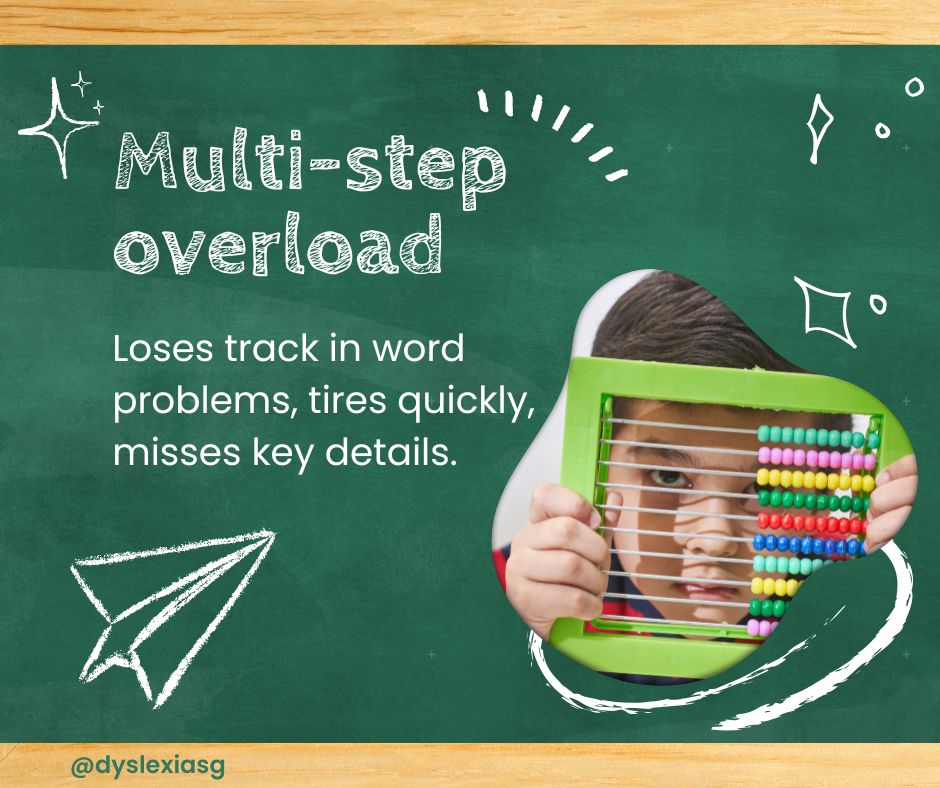
5. Issues with Sequencing Steps and Staying Focused
- Some children struggle when mathematical tasks involve several steps. For example, in a word problem like “John has 12 marbles, gives 3 to his friend, and then buys 5 more. How many does he have now?” the child may lose track of the sequence, only doing one part of the problem or mixing up the order. They may also overlook key details, such as whether they are supposed to add or subtract.
- In learning settings, this might look like a child becoming easily distracted, tapping their pencil, or fidgeting whenever Mathematics homework is involved. Some may even appear unusually tired or mentally drained after working on just a few questions, as compared to other schoolwork.
In conclusion, while many children make occasional mistakes in Mathematics, persistent and consistent difficulties across these areas may point to more than just a lack of practice. When challenges such as recalling basic number facts, grasping mathematical concepts, sequencing logical steps, or connecting Mathematics to real-life situations interfere with learning and confidence, it can signal an underlying learning difficulty like dyscalculia. Early identification and support can make a significant difference.
If you notice these signs in your child and are concerned, consider arranging an assessment with the SpLD Assessment Services (SAS) at the Dyslexia Association of Singapore (DAS). Our team of registered psychologists can help you gain a clearer understanding of your child’s learning profile and provide recommendations for targeted support strategies.
Â
More Information about Maths Learning Differences:
https://www.pbs.org/wgbh/misunderstoodminds/mathdiffs.html
https://codereadnetwork.org/wpcontent/uploads/2019/03/Factsheet_Dyslexia_Mathematics.pdf
Find out more about DAS Services: