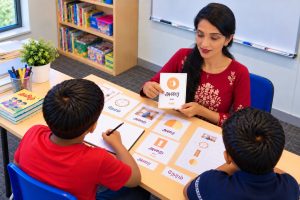
Helping your child practise phonics at home does not need to feel like another lesson. Simple games such as Sound Detective, I Spy with Sounds and Build Simple Words can fit into everyday routines, with no worksheets, flashcards or preparation needed.
Whether you are waiting for dinner or sharing a bedtime story, a few playful moments can help your child revisit the sounds and letters they are learning in school. These activities are especially useful for preschoolers who are beginning to learn letter sounds and blend simple words.
What is phonics?
Phonics teaches children to connect letters, or groups of letters, with the sounds they represent. Children use these connections to sound out written words and blend the sounds together to read.
Listening for sounds in spoken words is a related skill called phonemic awareness. Some of the games below focus on hearing sounds, while others help your child connect those sounds to printed letters. Both give you ways to practise together through play.
How can parents practise phonics at home without preparation?
Use familiar objects, printed letters around you and books you already have. Ask your child to spot something beginning with a particular sound, find a letter that represents it, or blend spoken sounds into a familiar word.
Start with sounds your child has learnt in school and keep the activity short. You can try a five-minute game, but even one question during an everyday routine gives your child a chance to practise.
Here are five easy games to get you started.
1. Sound Detective
Help your child notice the first sound in familiar words.
Choose a sound, such as the sound at the beginning of “ball”, and ask your child to find something nearby that begins with the same sound. They might spot a book, bag or banana.
You could say, “Let’s find something that starts with the sound /b/.”
Try this at home, in the supermarket or on a walk. Take turns being the detective so your child can also choose a sound for you.
Use the letter sound rather than the letter name. If your child needs help, point to an object and say its name together, drawing attention to the first sound.
2. I Spy with Sounds
Help your child match a beginning sound to an object they can see.
Choose one object in view and give your child a sound clue: “I spy with my little eye something beginning with /t/.”
Your child might guess “table”, “toy” or “towel” before finding your chosen object. Unlike Sound Detective, where any matching object counts, this game asks your child to work out which object you have picked.
Play while waiting for food or tidying toys. If your child finds it difficult, offer two choices: “Is it the table or the chair?”
3. Tap the Letter
Help your child connect printed letters with their sounds.
When you notice letters on a cereal box, sign or book cover, choose a letter your child already knows. Say its sound and ask your child to tap the matching letter.
For example, if you can see the letter s, ask, “Can you find the letter that makes the /s/ sound, like at the beginning of ‘sun’?”
You can also point to a familiar letter and ask your child what sound it represents. If they are unsure, say the sound and let them try with you.
Start with clear, easy-to-spot letters so your child can focus on making the connection between the letter and its sound.
4. Build Simple Words
Help your child practise blending sounds into words.
Choose a short, familiar word such as “sat”. Say its sounds separately, /s/ /a/ /t/, then encourage your child to blend them together: “sat!”
Use the sounds the letters represent, rather than saying the letter names. Begin slowly, then bring the sounds closer together to help your child hear the word.
Other words to try include “cat”, “pig” and “sun”.
When your child is comfortable blending, try changing one sound. For example, say, “If we change the first sound in ‘cat’ to /h/, what word do we get?” Say the new sounds together if needed: /h/ /a/ /t/ makes “hat”.
This spoken game practises listening and blending. If you happen to spot a suitable word in a book, you can also point to its letters as you say the sounds.
5. Bedtime Sound Hunt
Help your child explore sounds during a shared story.
During story time, occasionally pause at a familiar word and ask about its first sound.
For example, read the word “bear” aloud and ask, “What sound can you hear at the beginning of ‘bear’?”
You can also look at an illustration together and ask, “Can you find something in this picture that begins with /s/?”
To include letter recognition, point to a familiar printed letter and ask your child to say its sound.
Keep these pauses brief. If your child would rather listen to the story, model the answer and continue reading. Enjoying the book together remains the priority.
How can you keep phonics games fun?
Keep the games short and follow your child’s interest. One sound while packing a bag or one word during story time may be enough.
Start with familiar sounds. Use the letter sounds your child is already learning in school. If you are unsure, ask their teacher which ones to practise.
Praise the effort. A simple “You listened carefully to that first sound” acknowledges what your child has done.
Model the answer when needed. Say the sound or word gently, then give your child a chance to join in without repeated testing.
Pause when your child has had enough. If they are tired or frustrated, leave the game and try again another time.
Common questions about phonics games at home
Do I need flashcards or worksheets to practise phonics?
No. You can use everyday objects for listening games and the letters on packaging, signs or books for letter-sound practice. The activities above use things already around you.
Should I use letter names or letter sounds?
For these games, use letter sounds. When blending “cat”, for example, say the sounds represented by c, a and t rather than the letter names “see”, “ay” and “tee”.
What if my child cannot blend sounds yet?
Model a short word and blend it aloud for your child to hear. You can also return to simpler games, such as finding objects that share a beginning sound. Choose activities your child can enjoy and ask their teacher which sounds or skills to revisit at home.
How long should a phonics game last?
Keep it brief and guided by your child’s interest. A few minutes, or even a single turn, can fit into your day without becoming another lesson. There is no need to complete every game or keep playing when your child wants to stop.
Make room for small moments of phonics play
You do not need to turn home time into teaching time to help your child practise phonics. An object spotted on a walk or a letter noticed on a cereal box can become an opportunity to explore sounds together.
These no-prep games help your child revisit what they are learning in school while keeping practice relaxed and enjoyable. Start with one game that fits your routine and follow your child’s curiosity.