SpLD Assessment

SpLD Assessments

The SpLD Assessment Services (SAS) seeks to identify the learning needs of those who experience academic challenges. As a gateway to the DAS programmes and services, the SAS team works with parents, teachers and students to understand their concerns in order to connect them with the support they need.

For those who need further clarification on their or their child’s learning needs, the SAS conducts comprehensive psycho-educational assessments to establish a unique profile of strengths and weaknesses that lead them to the necessary support.

We support all age groups, from preschool learners to working adults.

Through comprehensive psycho-educational assessments, our psychologists help individuals find out how they learn or work differently. In doing so, they are able to access the support that aligns with their needs, be it through educational interventions, accommodations and/or learning strategies.

From time to time, due to changes in learning profile or academic demands, students may find it hard to cope with their learning challenges despite already receiving support. In these situations, a review assessment is strongly recommended in order to identify the changes that should be made to their existing system of support.

SAS psychologists also provide consultation sessions to parents of learners and adults who maybe unsure of their specific next steps if their child or they themselves encounter difficulties in school or at the workplace, due to their academic difficulties.

We recognise that some individuals may not meet the official criteria for a diagnosis such as dyslexia but still experience significant challenges in learning. These difficulties are no less important. At DAS, we provide targeted support for such learners to ensure their needs are not overlooked. Early intervention, even without a formal diagnosis, can lead to meaningful improvements in confidence and academic outcomes. Read more about this here in a featured article on Channel NewsAsia.

In line with our belief that support should be accessible, bursaries are available for those who need them.

We seek to profile the needs of every learner, and for them to discover and understand their potential.

More students with specific learning differences in Singapore are receiving access arrangements for national exams, such as the PSLE and O-levels. These arrangements include provisions like extra time, assistive technology, separate rooms, or one-on-one invigilation. They are designed to ensure that students with physical, cognitive, or emotional challenges are assessed fairly. Educators and experts emphasise that these measures do not give students an unfair advantage but help create equal opportunities for them to show their true potential.

As featured in The Straits Times, read the full article by Dr Geetha Shantha Ram, Director of the English Language and Literacy division.

Should you have any queries, please call our hotline at 6444 5700, or email us at [email protected]

OUR PSYCHOLOGISTS

The SAS comprises a team of Registered Psychologists, Senior Specialist Psychologists as well as Specialist Psychologists who receive intensive training to ensure that they are well skilled to carry out psycho-educational assessments. Besides supporting those who learn differently, SAS psychologists contribute to the community with their work with professionals from different Social Service Agencies and organisations as well as parents to empower them. Our psychologists are also constantly undergoing professional development, such as attending related seminars/talks, conducting research, presenting at conferences, and inviting consultants to learn from their expertise. We also have a team of Referral Reading Officers (RRO) and Student Services Officers (SSO) who provide screening services and administrative support.

The Specialist Psychologist has a first degree in Psychology and his/her work is supervised by a Registered Psychologist. He/She is trained to assess for dyslexia at the DAS.

The Senior Specialist Psychologist has a first degree in Psychology, has worked for more than 4 to 5 years in the capacity of a Specialist Psychologist at the DAS and his/her work is supervised by a Registered Psychologist. He/She may also have a Masters in the field of Psychology but has yet to attain registration status. He/She is trained to assess for dyslexia and other SpLDs at the DAS.

The Registered Psychologist has been awarded a Masters or Doctoral degree in Psychology from a recognised institution. He/She is registered with a recognised national registration board (such as the Singapore Psychological Society).

The Referral Reading Officer has a degree or diploma in Psychology. He/She supports the processing of referrals to the DAS and is involved in the screening of students for dyslexia. Referral Reading Officers work closely with both the administrative colleagues and psychologists within the team.

Student Services Officers support the administrative functions within the team, such as the processing of referrals, scheduling of appointments, and supporting the screening process. They work closely with the team to ensure the smooth provision of services by the team.

WHAT IS AN ASSESSMENT?

A psycho-educational assessment is an evaluation of an individual’s cognitive abilities, academic skills and/or behaviours to determine their areas of strengths and weaknesses. Such assessments can serve to ascertain if an individual has a learning or neurodevelopmental difficulty, as well as to identify areas of learning needs. Findings from a psycho-educational assessment can help to identify suitable avenues of support as well.

Screening Tests

A psycho-educational assessment is different from a screening test. For parents who have sent their child for screening prior to this application, please be aware that results from these screenings only yield an at-risk indication and cannot be taken to be confirmation of having a specific learning difficulty Such a diagnosis can only be obtained through a formal assessment by a psychologist, psychiatrist, occupational therapist, and/or speech and language therapist, depending on the nature of the concern.

WHAT DO WE ASSESS FOR?

SpLD Assessment Services (SAS) aims to be a one-stop assessment centre, where various referral concerns can be addressed. Psycho-educational assessments are conducted for struggling learners ranging from  preschool age to tertiary level students. Assessments and consultations are also available for adults with literacy concerns.

We offer the following range of assessments:

Assessment Type

Age group

Dyslexia

a specific learning difficulty in reading, spelling and writing

All age groups – from children to adults.

Children who are at least 6 years old (For children who are 6 years old, it is recommended that they receive at least 6 months of phonics intervention prior to the assessment)

Dyscalculia

a specific learning difficulty in Mathematics

Children who are at least 7 years old

Attention Deficit Hyperactivity Disorder (ADHD)

a neurodevelopmental disorder where there is increased inattention, disorganisation and/or hyperactivity/impulsivity

Autism Spectrum Disorder

a neurodevelopmental disorder where there are deficits in social communication and interaction, as well as the presence of restricted and repetitive patterns of behaviour and interests

Intellectual Disability

a disorder where there are deficits in intellectual and adaptive functioning

Children who are at least 6 years old

Giftedness

where an individual shows exceptionally well-developed intellectual abilities

Children who are at least 5 years old

School Readiness

whether a preschooler is ready to access mainstream primary school education

Children who are 5 and 6 years old only

Other Services

Consultation

Speak to our registered psychologist regarding your concerns and address any queries you have.

Working adults are strongly recommended to consult our registered psychologists before proceeding with an assessment. Please note that an hourly rate will be charged.

Supporting letters

Parents can request letters supporting the application of access arrangements for assessments conducted by DAS psychologists, within 3 years of the assessment date. The first supporting letter following assessment will be written at no cost, and subsequent letters will be chargeable at prevailing rates.
Please note that request for a supporting letter will be evaluated on a case by case basis.

WHAT CAN I EXPECT FROM AN ASSESSMENT?

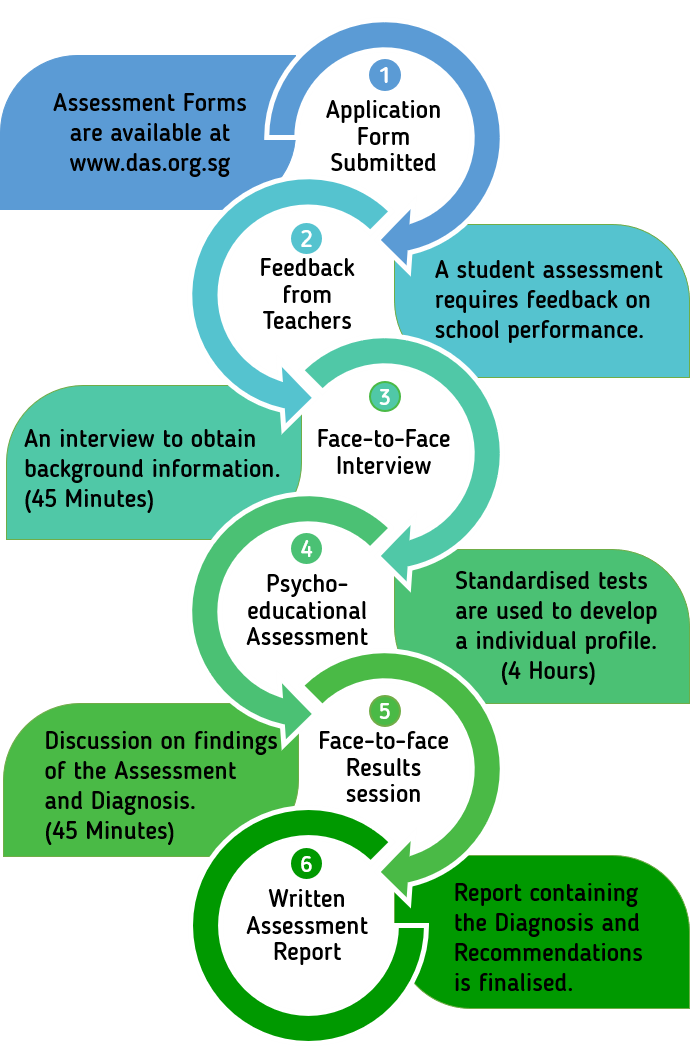
Depending on the type of psycho-educational assessment to be conducted, the tests administered and session duration will differ. The follow details a typical diagnosis process:

One password-protected soft copy psychological report will be provided for each assessment.

Clients can also request for additional copies of the report that can be provided at no charge within a month of the original report sent date, limited to the following quantity:

  1. One additional soft copy (i.e. one additional email)
  2. Up to two hard copy reports within a month of the date that the initial report was sent.

The provision of additional reports will be chargeable at prevailing rates, if the above-mentioned number of reports have been provided, or if requests are made one month after the date on which the original report was sent.

Appointments for assessments are typically scheduled within 4 to 8 weeks once all required documents are submitted and reviewed.


Workshops to Help Your Child Grow

Every child’s journey is unique, and a little extra support can go a long way. Our workshops are designed to help children build confidence, learn social and emotional skills, and get ready for new milestones in school and life. Led by DAS psychologists, each session is fun, hands-on, and tailored to your child’s age and stage.

Emotion Explorers Camp

This holiday workshop supports primary school children in developing emotional literacy, providing a foundation for effective learning. As they grow more skilled at recognising, expressing, and managing their emotions, their self-esteem and confidence increase, focus improves, and self-regulation is strengthened.

What Your Child Will Learn:

  • How to recognise emotional cues
  • How to name and express feelings effectively
  • Identify emotional triggers
  • Simple strategies to calm down

This workshop is designed for Primary 1 to 6 students.

Workshops are conducted by the DAS psychologists

Upcoming Runs:

Date: TBA
Time: TBA
Location: TBA

Click here to express your interest

Testimonials

Parents observed meaningful changes in their child’s emotional growth and development following the workshop.

“My child has improved a lot in regulating her emotions.”

• “After the workshop, my daughter began to talk more openly about her feelings.”

• “My child has learned not to become overwhelmed as easily and has shown fewer emotional outbursts since attending the workshop.”

• “My son is now able to calm himself down, manage his emotions better and recover more quickly when he feels upset.”

Getting Ready for Primary School

For Kindergarten 2 Students

Give your child a head start in primary school with our engaging workshop! The session also offers practical tips for parents of children with learning difficulties to support a smoother transition.

What Your Child Will Learn:

  • Practical life skills such as navigating the school environment and purchasing food from the canteen
  • Social skills like taking turns and making request
  • Simple strategies to manage emotions

Workshops are conducted by the DAS psychologists

Upcoming Runs:

Date/Time: TBA

Click here to express your interest

Testimonials

Parents shared positive feedback on their experience, highlighting the value of the workshop content, parent session and practical resources provided.

“The workshop content was highly helpful in preparing my child for primary school and gave me greater confidence in supporting their learning journey.”

“The parent information session was informative and provided practical insights that helped me better understand how to support my child.”

“The resources shared during the workshop were useful, relevant and easy to apply at home.”

Ready, Set, Connect!

This group-based programme, running over 5 sessions, helps Primary 1 to 3 children build foundational social skills through play, storytelling, and modelling. By focusing on social observation, basic emotional regulation, and problem-solving, it aims to strengthen the child’s ability to form positive peer relationships, navigate social situations, and cope effectively in social settings.

What Your Child Will Learn:

  • Emotion identification and regulation
  • Recognise social cues
  • Social problem-solving skills (i.e., sharing, teamwork, using polite words)


Duration:
5 sessions, 1.5 hours each

This programme is conducted by DAS psychologists.

Upcoming Run:

Date: 16, 23, 30 September, 7, 14 October 2026
Time: 4.00 PM to 5.30 PM
Location: DAS Bishan Learning Centre
Fees: $850 inclusive of GST

Click here to register

Testimonials

Parents noticed positive changes in their child’s social awareness, emotional understanding and interactions with others after the programme.

“My son has started showing greater empathy and consideration towards others.”

• “My daughter is now better able to express her feelings and understand the emotions and behaviours of those around her.”

• “The programme helped my child develop better self-control and manage his emotions more effectively.”

Frequently Asked Questions (FAQ)

Understanding whether your child needs an assessment

You may wish to consider an assessment if you or your child’s teachers have noticed ongoing difficulties with learning, attention, communication, or behaviour that are affecting your child’s functioning at school or at home.

While these signs do not necessarily indicate a specific diagnosis, an assessment can help clarify your child’s strengths, areas of difficulty, and the most appropriate next steps. If you are unsure, you can complete our brief checklist or reach out to us through our enquiry page for further guidance.

A dyslexia screening is a brief evaluation (about 15 to 20 minutes) that estimates your child’s likelihood of having dyslexia. It does not result in a diagnosis.

A full assessment is a comprehensive testing process conducted by a psychologist (about 3 to 4 hours) to determine whether your child meets the criteria for a diagnosis of dyslexia and to provide recommendations for support.

At DAS, your child must be at least six years old on the date of the assessment. This is determined based on your child’s exact date of birth, rather than the calendar year in which they turn six. Your child must also have completed at least six months of structured phonics intervention or formal education before the assessment.

If your child is in preschool (Kindergarten 1 and 2) and requires foundational literacy support, they may benefit from enrolling in the DAS Preschool Programme.

No, we assess for a range of areas, such as dyslexia, dyscalculia, attention-deficit/hyperactivity disorder (ADHD), autism spectrum disorder (ASD), intellectual disability (ID). We also provide evaluations for giftedness and school placement purposes. DAS SpLD Assessments

If you are unsure which assessment is most appropriate for your child, you can contact us through our enquiry page. A member of our team will discuss your concerns and guide you towards the most suitable assessment.

For more information about the various assessment services we offer, you can refer to this page.

AI tools can provide general information and highlight possible concerns, but they cannot administer standardised assessments, observe your child’s behavior in a structured setting, or interpret results within the context of your child’s developmental, educational, and family history.

A formal assessment by a qualified psychologist provides an accurate diagnosis, individualised recommendations, and documentation that may be required for school support, accommodations, and access to intervention services.

Cost and Timeline

Assessment fees vary depending on the type/number of areas to be investigated, citizenship, and age group (post-secondary and above are considered adults). The final fee will be confirmed upon review of the application. For more information, visit Assessment Fees.

While these signs do not necessarily indicate a specific diagnosis, an assessment can help clarify your child’s strengths, areas of difficulty, and the most appropriate next steps. If you are unsure, you can complete our brief checklist or reach out to us through our enquiry page for further guidance.

No, the assessments are not subsidised by MOE. However, financial assistance for eligible individuals is available.

Yes, financial assistance is available for eligible Singapore Citizens who are full-time students aged 25 and below. To apply, visit Financial Assistance.

Once all required documents have been received and reviewed, assessment appointments are typically offered within four to eight weeks. Actual waiting times may vary depending on appointment availability and the type of assessment required. Please visit our website for the latest estimated waiting time.

To process your child’s application, we will require: 

  1. Your child’s birth certificate
  2. A Teacher’s Questionnaire completed by their current teacher
  3. Relevant reports from schools, hospitals or other professionals, where applicable
  4. Supporting financial documents if you are applying for financial assistance


We can only review and process the application after all required documents have been received. Incomplete information may delay the review of your application and the allocation of an appointment.

During the Assessment

Assessments are conducted by trained specialist psychologists and registered psychologists from the DAS SpLD Assessment Services (SAS) team.

While these signs do not necessarily indicate a specific diagnosis, an assessment can help clarify your child’s strengths, areas of difficulty, and the most appropriate next steps. If you are unsure, you can complete our brief checklist or reach out to us through our enquiry page for further guidance.

Most assessments typically take around 3 to 4 hours. The psychologist will work at a pace that is appropriate for your child, with breaks provided where needed. If your child needs additional time or is unable to complete the assessment in one session, a follow-up session can be arranged where appropriate.

Depending on the assessment type, your child will complete a series of age-appropriate, standardised activities and tests.

These may assess areas such as reading, writing, mathematics, thinking skills, language, memory, attention, or behaviour, depending on the reason for the assessment. The findings help us make recommendations to best support your child’s learning.

No special preparation is required, as the assessment aims to understand your child’s current abilities.

Simply ensure that your child is well-rested, has had a meal beforehand, and comes ready to do his/her best. They may also bring along a water bottle, light snacks, and a sweater to help them stay comfortable during the assessment.

Our psychologists are experienced in working with children of different ages and needs, and will take time to help your child feel comfortable before the assessment begins.

Throughout the assessment, they will work at your child’s pace and provide appropriate support, such as breaks where needed. If your child is unable to complete the assessment in one session, we can arrange a follow-up session to complete the remaining assessment activities.

Parents are generally not present during the assessment so that the results reflect their child’s own abilities without unintentional influence or prompting.

Our psychologists are experienced in helping children feel comfortable and engaged, and parents will have opportunities to share relevant information before the assessment and discuss the results with the psychologist afterward.

Results and Next Steps

Assessment results and recommendations will be shared with you approximately 2 weeks after the assessment process has been completed during a feedback session, which may be conducted either virtually or in person.

A written report will typically be provided within 6 to 8 weeks of the assessment

If your child is not diagnosed with dyslexia, the psychologist will explain the assessment findings and discuss the most appropriate next steps based on your child’s needs.

Depending on the findings, recommendations may include intervention (including DAS services where appropriate), learning strategies, or referrals to other professionals or services.

Yes, DAS reports are recognised by schools in Singapore. Where appropriate, recommendations for access arrangements will be included based on your child’s assessment findings. The final decision on eligibility rests with the relevant school or examination authority.

After the assessment, your child’s psychologist will schedule a feedback session with you to explain the findings, discuss your child’s learning profile, and answer any questions you may have. Recommendations and next steps will also be discussed during the feedback session.

A comprehensive written report will also be prepared and sent to you thereafter.