Written by:
Rahayu Rahiman, Lead Educational Therapist and
Babe Chen, Educational Therapist
Many parents ask us the same question: “How can I support my child’s literacy development at home?” The good news is that you do not need special training or long lessons to make a difference. Short, playful interactions woven into everyday routines can help reinforce the skills children are learning during intervention sessions.
Research conducted in Singapore by the National Institute of Education found that children’s home literacy environment plays an important role in the development of early literacy skills. Regular parent–child literacy experiences, such as shared reading and meaningful interactions with print, are associated with stronger emerging English literacy skills in preschoolers (O’Brien et al., 2020)
Build Literacy into Everyday Routines
Daily routines provide natural opportunities to reinforce learning without adding extra pressure to busy schedules.
🏡 Around the Neighbourhood
Turn your child into a “letter detective” by looking for objects that begin with a target sound.
“Can you find something that starts with /b/?”
Possible answers: bus, bird, bag.
🚌 Learning on the Go
During MRT rides or car journeys, say a word slowly by sounds and let your child guess it.
“Wh-ee-l” → wheel
🍽️ Mealtime Sound Hunt
Ask for the first sound in foods such as broccoli (/b/), fish (/f/), peas (/p/), or orange (/o/).
Ask for ending sounds as in egg (/g/), yolk (/k/), toast (/t/) or bread (/d/)
🛒 Grocery Shopping
Choose items from the basket and talk about their beginning or ending sounds.
“Milk starts with /m/.” “Chip ends with /p/.”
🌙 Bedtime Sound Check
Use bedtime words such as toothbrush, wash, and soap.
“Which word has the /sh/ sound?”
Extend Learning Through Play
🎲 Toy & Word Surprise Game
Child picks a toy (e.g., red aeroplane) and a sight-word card (e.g., card labelled ‘ride’), then makes a sentence.
“I ride the red aeroplane.”
This combines seeing, touching, and saying, which supports multisensory learning.
🔤 Build-a-Word Game
Use magnetic letters or paper letters.
cat → hat → hot
Children learn that changing one letter changes the whole word.
👜 Mystery Bag Description Game
Child describes a hidden object before revealing it.
Example: “It’s round, it can roll and it can bounce.” Answer: ball
This builds vocabulary and verbal expression.
📚 Story Retelling
After reading, ask your child to retell the story using toys, puppets, or drawings.
Focus on simple questions: Who? What? Where?
Keep in Mind
- Keep activities short (5–10 minutes).
- Praise effort instead of perfection.
- Follow your child’s interests.
- If your child becomes tired or frustrated, pause and try again another day.
Remember: consistency is more important than completing every activity perfectly.
Conclusion
Supporting literacy at home does not need to feel overwhelming. By turning everyday moments into opportunities for conversation, reading, and play, parents can help reinforce the skills their children are developing during intervention. Small, positive experiences repeated consistently can build confidence, strengthen emerging literacy skills, and nurture a lifelong love of learning.
Reference
O’Brien, B. A., Ng, S. C., & Arshad, N. A. (2020). The structure of home literacy environment and its relation to emergent English literacy skills in the multilingual context of Singapore. Early Childhood Research Quarterly, 53, 441–452. https://doi.org/10.1016/j.ecresq.2020.05.014
DAS offers free online preschool screenings for K1 and K2 children. These screenings help determine whether:
• Your child is meeting expected literacy milestones
• There may be early learning gaps
• Your child could benefit from the DAS Preschool Programme
Register for Preschool Screening now!
Click here to find out more about the Preschool Programme.
Download the Parent Checklist to understand your child’s development.
Looking for Guidance on Your Child’s Reading Journey?
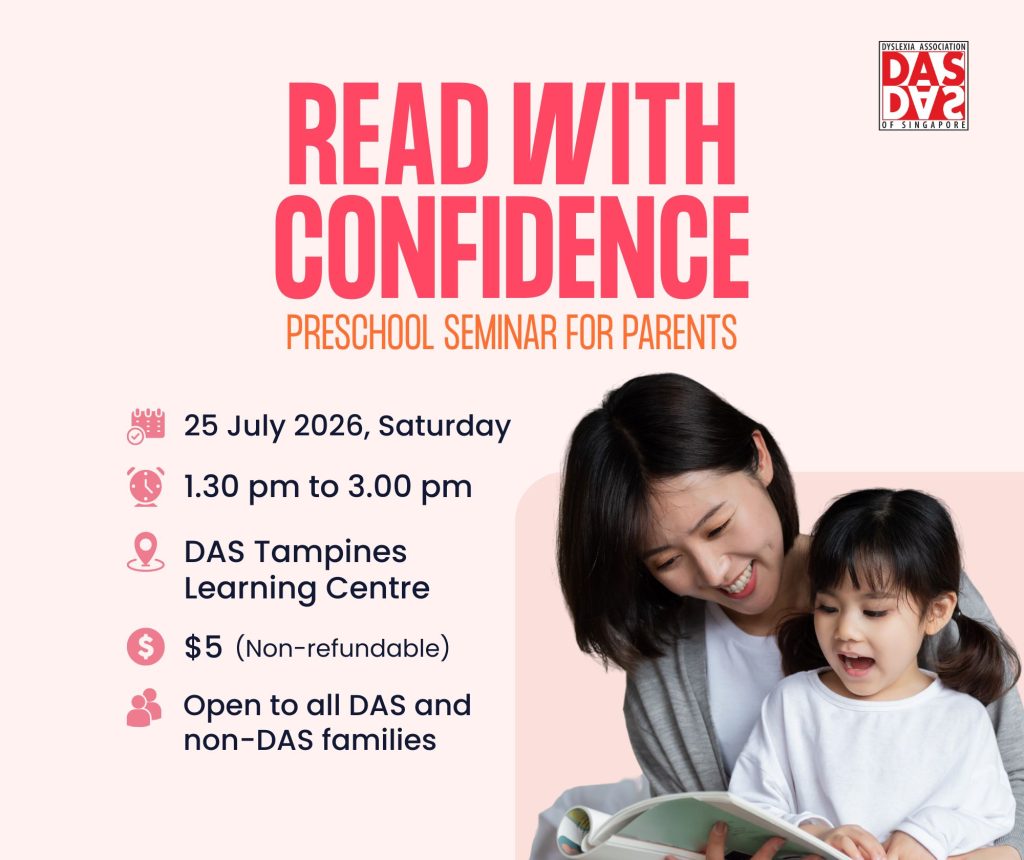
Join our Preschool Parent Seminar and leave with practical strategies, expert guidance and greater confidence to support your child’s reading journey.
You will learn:
- How to recognise the early signs
- How to assess your child’s reading ability
- Simple ways to support reading at home
- How to monitor their development